Should You Buy a House With a Legal Basement, or Legalize the Basement Later in Ontario?
Pay the premium for a basement apartment that is already approved, or buy cheaper and convert it yourself? The comparison that decides it is total project cost, not purchase price.
The short answer
A finished basement is not a legal second unit in Ontario; a separate entrance, a kitchen and a bathroom establish nothing on their own. Compare total project cost rather than purchase price, because the conversion route also carries permits, financing, lost rent and contingency. Robin Patel tests that feasibility with buyers before an offer goes firm.
Written forFirst-time buyers and investors across the GTA who are counting on basement rental income to make a purchase work.
The short version
- A finished basement is not a legal basement apartment — a separate entrance, kitchen and bathroom do not establish legal status in Ontario.
- Compare total project cost, not purchase price: the conversion route has to carry permits, design, financing, lost rent, contingency and your time before the two options are comparable.
- Work out the legal-basement premium — the price difference between comparable homes with and without an approved unit — and test it against the realistic all-in conversion cost.
- Ceiling height and fire separation are the two physical constraints most likely to make a basement unconvertible, and both should be checked before you buy, not after closing.
- If the basement income is essential to your plan, confirm feasibility with the municipality and qualified professionals before making a firm offer.
The question buyers actually ask
One of the most common questions Robin hears from buyers looking for a home with rental-income potential is this: should I pay more for a house that already has a legal basement apartment, or buy a cheaper house and make the basement legal myself?
There is no single answer for every buyer. A house with an existing legal basement can provide convenience, greater certainty and potentially immediate rental income. Buying a suitable house without one and converting it afterward may allow you to buy at a lower price and design the basement around your own needs.
The key word is suitable. Not every basement can be converted into the legal apartment you have in mind. Before paying a premium — or assuming you can legalize a basement after closing — investigate the property, the zoning, the permits, the physical layout and the realistic conversion cost.
Quick answer
For a first-time buyer who depends heavily on basement rental income, Robin generally prefers a property where the basement unit is already properly approved and documented — provided the buyer and their professionals verify that status.
For a buyer who has sufficient cash, time and renovation tolerance, buying a house with a good basement configuration and creating a legal second unit afterward can sometimes provide better long-term value.
The most important calculation is this. Purchase price, plus legalization and renovation costs, plus financing costs, plus carrying costs, plus contingency — compared against the purchase price of a comparable home that already has an approved unit. Do not compare purchase prices alone.
Legal basement and finished basement are not the same thing
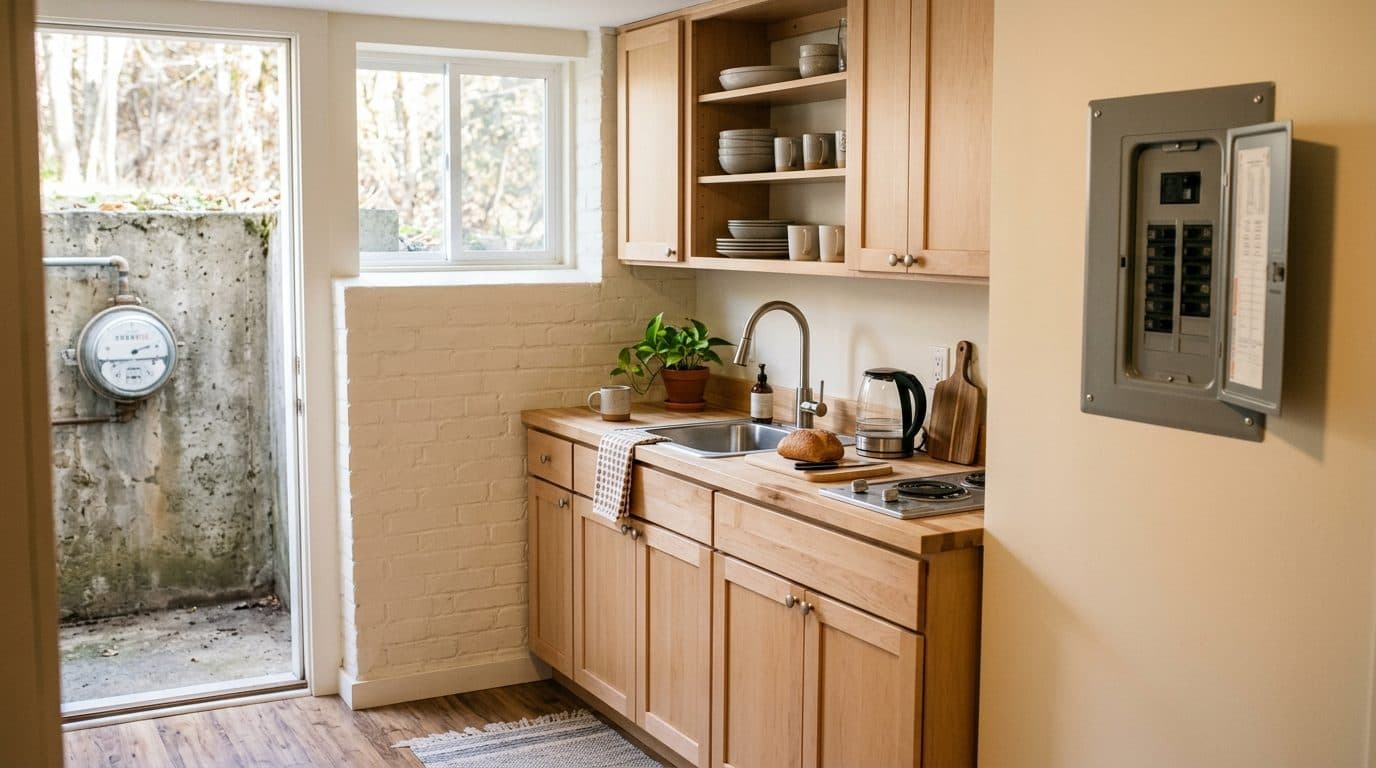
The distinction is the whole question. A beautiful finished basement is not automatically a legal basement apartment. A basement can have bedrooms, a bathroom, a kitchen, a separate entrance and excellent finishes and still not be approved as a legal second dwelling unit.
Ontario describes a second unit as a self-contained dwelling unit containing its own kitchen, bathroom facilities and sleeping areas. Creating one brings in a whole set of requirements, and those requirements vary by property and by municipality.
Never assume that separate entrance plus kitchen plus bathroom equals a legal basement.
- Municipal zoning requirements
- Building permits and Building Code compliance
- Municipal inspections
- Fire separation
- Smoke and carbon monoxide alarms
- Safe exits and windows
- Plumbing, electrical work, heating and ventilation
- Ceiling heights
- Parking or other local requirements where applicable
- Municipal registration or licensing where applicable
Option 1: buy a house that already has a legal basement apartment
For many first-time buyers this is the simpler option, and the advantages are mostly about risk and certainty rather than money.
Less renovation risk. If the unit has been properly approved and the documentation is available, much of the construction and approval work has already been done. You may avoid months of designers, contractors, permits and inspections.
Rental income sooner. If the unit is vacant and ready to rent, you may be able to start the rental process much sooner than if you have to renovate first. If it is already tenanted, landlord-and-tenant considerations become important instead.
Better cost certainty. You know the purchase price before closing. When you legalize a basement afterward, the final cost can move, because opening walls can uncover electrical issues, plumbing problems, insufficient insulation, fire-separation deficiencies, structural issues, HVAC requirements, drainage problems, window modifications and ceiling-height complications.
Less construction stress. Renovating immediately after buying your first house is not for everyone. You may already be absorbing mortgage payments, property taxes, moving expenses, furniture, closing costs, utility setup and ordinary home repairs. A major basement project on top of that adds both financial and personal strain.
Documentation helps your due diligence. When a seller says a basement apartment is legal, ask for supporting documentation rather than relying on the listing description — permits, inspection records and other municipal documentation, depending on the property and municipality.
The disadvantages of buying a house with an existing legal basement
You may pay a premium. A house with a properly completed legal second unit attracts more buyers — particularly investors and first-time buyers looking for rental income — and that can show up in the price.
You inherit someone else’s design. Maybe you wanted two bedrooms instead of one, a better kitchen layout, separate laundry, more storage, better soundproofing, different flooring or a more functional entrance. An existing basement can be legal and still not be ideal.
Legal does not mean perfect. Building Code compliance does not mean the workmanship, finishes or layout meet your expectations. You still need proper home-buying due diligence.
Existing tenants change the analysis. If the property is sold with a tenant occupying the basement, understand the tenancy before purchasing. The lease, the rent, deposits, tenant history and Ontario’s landlord-and-tenant rules can materially affect the purchase.
Option 2: buy a house without a legal basement and legalize it later
This strategy can work extremely well — but only when the property is suitable.
Potentially lower purchase price. A home without a legal basement apartment may sell for less than a comparable property that already has one, and that difference can fund part or all of the conversion.
You control the design. This is one of the biggest advantages: the number of bedrooms, kitchen location, bathroom layout, laundry arrangement, flooring, lighting, storage, soundproofing, the separate entrance configuration and the quality of finishes. You can design the basement around the tenant or family use you actually expect.
Potential to create value. If you buy the right property and complete a compliant second unit professionally, you may improve the functionality and marketability of the home. Do not assume every dollar spent adds a dollar to resale value — that depends on the market, location, quality, layout and buyer demand.
You know how the work was done. When you manage the project, you keep the permits, plans, invoices, inspection records and contractor information. That documentation is valuable when you eventually sell.
The disadvantages of legalizing a basement yourself
Construction costs can increase. Your initial budget is not necessarily your final budget. Unexpected conditions are common when renovating existing homes, which is why a contingency reserve matters.
Approval takes time. A legal conversion is not simply a renovation. Ontario recommends checking with the local planning and building departments before proceeding. A building permit is generally required when adding a second unit, and municipal inspectors review the work at different stages.
The property may not be suitable. This is the biggest risk. Imagine buying a house specifically because you plan to create a basement apartment, and discovering after closing that your intended design cannot be approved without major changes. The obstacles can be ceiling height, entrance configuration, windows, fire separation, plumbing, HVAC, electrical systems, parking, zoning, septic capacity where applicable, or structural limitations. Ontario’s own guidance recommends contacting the municipal planning and building departments before deciding to add a second unit.
Lost rental income during construction. If the completed basement could rent for a given monthly amount and construction plus approvals take several months, the rent you did not collect during that period is a real cost of the do-it-yourself route. Put that opportunity cost in the comparison.
Side by side
Comparing the two routes factor by factor makes the trade clearer: you are buying certainty in one case and flexibility in the other.
- Purchase price — potentially higher with an existing legal unit, potentially lower if you convert
- Renovation required — usually less with an existing unit, potentially significant if you convert
- Rental readiness — potentially faster with an existing unit, delayed if you convert
- Construction risk and cost certainty — lower risk and higher certainty with an existing unit
- Design flexibility and opportunity to customize — low with an existing unit, high if you convert
- Permit process — may already be complete, or the buyer must complete it
- Immediate cash requirement — a higher purchase price, versus renovation funds after closing
- Unexpected costs — lower with an existing unit, potentially higher if you convert
- Documentation — you must verify the seller’s records, or you retain your own
- Best suited for — the convenience-focused buyer, versus the value-add renovation buyer
| Factor | Existing legal unit | If you convert |
|---|---|---|
| Purchase price | Potentially higher | Potentially lower |
| Renovation required | Usually less | Potentially significant |
| Rental readiness | Potentially faster | Delayed |
| Design flexibility and opportunity to customize | Low | High |
| Permit process | May already be complete | The buyer must complete it |
| Immediate cash requirement | A higher purchase price | Renovation funds after closing |
| Unexpected costs | Lower | Potentially higher |
| Documentation | You must verify the seller’s records | You retain your own |
| Best suited for | The convenience-focused buyer | The value-add renovation buyer |
The financial calculation buyers should actually make
Here is a better way to compare two houses. For the house that already has an approved unit, your effective acquisition cost before normal closing costs is essentially the purchase price. For the house you intend to convert, it is the purchase price plus the complete basement project cost.
That comparison is where most buyers stop, and it is where most buyers get it wrong, because the second number is not finished. You also have to add permit and design expenses, financing cost, lost rental income, the cost of construction delays, unexpected repairs, your own time, temporary living inconvenience and a contingency budget.
Add those in and a conversion that looked cheaper than the finished house can end up costing more. That is the whole point of the exercise: compare total project cost, not purchase price.
One of the most important issues: ceiling height
Basement height can decide, on its own, whether a property is a viable candidate. Ontario’s published second-unit guidance sets a minimum ceiling height over the required floor area, including the route to the exit, for the qualifying existing-house situations the guide covers. The applicable requirement depends on the house and on the current Building Code provisions.
If the basement is too low, solving the problem may require expensive structural work — or the conversion may simply not be practical. When you are buying specifically for a future basement conversion, basement height should be investigated before you buy, not after.
Fire separation is another major consideration
A second unit requires appropriate fire protection between dwelling units. Depending on the situation that can involve fire-rated construction, drywall, protected openings, appropriate doors, interconnected smoke alarms, HVAC-related protection and other fire-safety measures. Ontario’s second-unit guidance describes a required fire separation between units and common areas in applicable situations.
This is one of the clearest reasons why installing a kitchen in a finished basement does not make it a legal apartment.
Do not forget the electrical work
Electrical work associated with creating a second unit must comply with Ontario electrical requirements. Ontario’s second-unit guidance notes that the electrical work associated with adding the unit requires the appropriate electrical permit and inspection through the Electrical Safety Authority.
Budget beyond drywall, flooring and kitchen cabinets.
What about development charges?
There is some good news here. Ontario law provides development-charge exemptions for qualifying additional residential units in existing houses.
That is another reason to investigate the exact property and municipality rather than assuming the cost of creating an additional unit is the same as constructing an entirely new dwelling.
Before buying a house with an existing ‘legal basement’, ask for proof
Do not rely on listing language — legal basement, legal apartment, second unit, basement suite, in-law suite, separate entrance, income potential. MLS® wording is not proof of legal status.
Ask your REALTOR® and the appropriate professionals to investigate the documentation. Depending on the municipality and circumstances, that can include building permits and their status, final inspections, municipal records, second-unit registration or licensing where applicable, zoning compliance, electrical documentation, existing tenancy documentation, fire-safety requirements, and whether renovations were completed after the original approval.
MLS® wording is not proof of legal status.
Before buying a house you intend to convert
If your purchasing decision depends on being able to create a legal basement apartment, do as much investigation as reasonably possible before making a firm purchase decision. For the important questions, confirmation should come from the municipality and qualified professionals — not from assumptions made during a showing.
- Is a second unit permitted on this property?
- Is the basement high enough?
- Can the required entrance and exit arrangement be created?
- Are the windows adequate, or can they reasonably be modified?
- Can the required fire separation be achieved?
- What electrical upgrades might be required?
- Can the HVAC system accommodate the proposed configuration?
- Is the plumbing layout practical?
- Are there parking requirements?
- Does the municipality require registration or licensing?
- Are there outstanding permits or previous unapproved renovations?
- What is the realistic all-in conversion cost?
Which option is better for a first-time home buyer?
For many first-time buyers Robin favours certainty over unnecessary construction risk, especially when basement income is part of what makes the home affordable. If two otherwise comparable homes are available and the price difference is reasonable, he would often prefer the property with the properly documented legal second unit.
The reason is simply that a first-time buyer already has enough to manage: mortgage payments, property taxes, insurance, utilities, home maintenance, moving costs and emergency savings. A major construction project immediately after closing may not be what you want on top of that.
That said, if the premium for the legal-basement property is excessive and the search turns up another property that is a strong candidate for conversion, creating the second unit afterward can be an excellent value-add strategy.
Which option is better for an investor?
Investors should focus heavily on the numbers: total acquisition cost, total conversion cost, expected legal rent, operating expenses, vacancy allowance, financing costs, property taxes, insurance, maintenance and potential resale value. Then calculate the incremental return generated by the second unit specifically.
An investor with construction experience and available capital may prefer a value-add property. An investor who prioritizes immediate cash flow may prefer an existing approved unit.
Robin’s practical approach
When Robin is helping a buyer who wants basement rental potential, he does not look only at whether the basement is finished. He looks at the overall property strategy.
Consider two houses. One is more expensive with a beautiful legal basement, but a poor location, a small lot and a limited upstairs layout. The other is cheaper with an unfinished basement that has strong conversion potential, a better location, a better lot and a better main-floor layout. Robin would not automatically recommend the first just because the basement is already done.
Real estate is still about the whole property. Location, lot, layout, condition, future marketability, financing and long-term family needs can matter more than whether the basement is finished.
Which should you choose: an existing legal basement, or a conversion?
Buy the existing legal-basement house when basement income is important immediately, the documentation can be verified, the layout works well, the price premium is reasonable, you do not want construction risk, you have limited cash available after closing, and you value convenience and certainty.
Consider legalizing one yourself when the purchase-price discount is meaningful, the property appears suitable for conversion, professionals have reviewed the feasibility, you have renovation capital, you can tolerate delays, you want to customize the unit, and the projected all-in cost creates a worthwhile financial advantage.
The biggest mistake to avoid
Do not buy first and investigate legalization later, if the basement apartment is essential to your financial plan. Before making the purchase decision, investigate whether the property is realistically capable of becoming the type of legal second unit you want.
Ontario itself recommends speaking with the local municipal planning and building departments before adding a second unit, because zoning, Building Code requirements and other municipal rules all need to be considered. A purchase-price discount can disappear very quickly if the property needs major structural, HVAC, electrical, plumbing, entrance or window modifications.
Frequently asked questions
Is a finished basement automatically a legal basement apartment in Ontario? No. A finished basement is not automatically an approved second dwelling unit. Creating one involves applicable zoning, Building Code, permitting, inspection and other requirements.
Does a separate entrance make a basement legal? No. A separate entrance can be an important feature, but on its own it does not establish legal status.
Do I need a building permit to create a legal basement apartment? Ontario’s guidance states that adding a second unit to a house requires a building permit. Confirm the requirements for the particular property with the local municipality.
Can every basement be converted into a legal apartment? Not necessarily. Physical conditions and applicable municipal and Building Code requirements have to be reviewed.
Should I trust an MLS® listing that says ‘legal basement’? Treat it as information that requires verification. Ask for supporting documentation and conduct appropriate due diligence.
Is it cheaper to legalize the basement myself? Sometimes, but not always. Compare the purchase-price savings against construction, design, permits, financing, lost rent, contingencies and your time.
Does a legal basement increase home value? A properly completed additional dwelling unit can improve the usefulness and marketability of a property, particularly where rental-income properties are in demand. There is no guaranteed dollar-for-dollar return.
Can basement rent help me qualify for a mortgage? Potentially. How rental income is treated depends on the lender, the mortgage product, the property and the documentation. Have a mortgage professional confirm how much, if any, proposed or existing rental income can be used for qualification before you rely on it in your budget.
Final takeaway
The question is not simply legal basement or no legal basement. The better question is which property gives you the best combination of purchase price, legal rental potential, conversion cost, location, layout, financing and long-term value.
For buyers who want simplicity and immediate rental potential, paying a reasonable premium for a properly documented legal basement can make sense. For buyers with renovation capital, patience and access to qualified professionals, buying the right property at a discount and creating a legal second unit can be the better investment.
The key is to complete the feasibility and financial analysis before buying — not after closing.
Written by
Robin PatelSalesperson · The Agency Toronto
Updated
Published
Read in your language
A machine translation, not Robin’s words. For anything that decides money, ask him in Gujarati or Hindi directly.