Why Gujarati and Indian Families Choose Robin Patel for GTA Real Estate
A home purchase in a Gujarati or Indian family is rarely one person’s decision. This is how those conversations actually go — parents in the room, money arriving from India, and the pull between community and commute.
The short answer
Parents in a Gujarati or Indian family ask about the area, future value, the basement, the schools and how close the community is, and Robin Patel treats those questions as part of the analysis rather than beside it. The commute, the affordability and how the choice looks five years from now sit in the same conversation.
Written forGujarati and Indian families buying or selling in the GTA — including newcomers, multigenerational households, and first-time buyers whose parents are part of the decision.
The short version
- In many Gujarati and Indian families the purchase is a family decision — parents ask about the area, future value, the basement, schools and community, and those questions deserve real answers.
- Never assume a basement apartment or secondary suite is legal because it exists. Zoning, permits, fire requirements and municipal rules decide that.
- If family money is coming from India, expect lenders and lawyers to ask for documentation of the source and the transfer — plan it with professionals, not with social-media advice.
- Do not pick a city only because relatives live there. Commute, employment, affordability and a five-year view should carry equal weight.
- Your first property does not have to be your forever property; a condo or townhouse can be a more manageable entry than a detached home bought under pressure.
For many families this is not only a financial transaction
For many Gujarati and Indian families, buying a home in Canada represents stability, family, community, education, opportunity — and establishing roots in Canada.
Robin understands this because real estate conversations with Gujarati and Indian families frequently go beyond bedrooms, bathrooms and square footage.
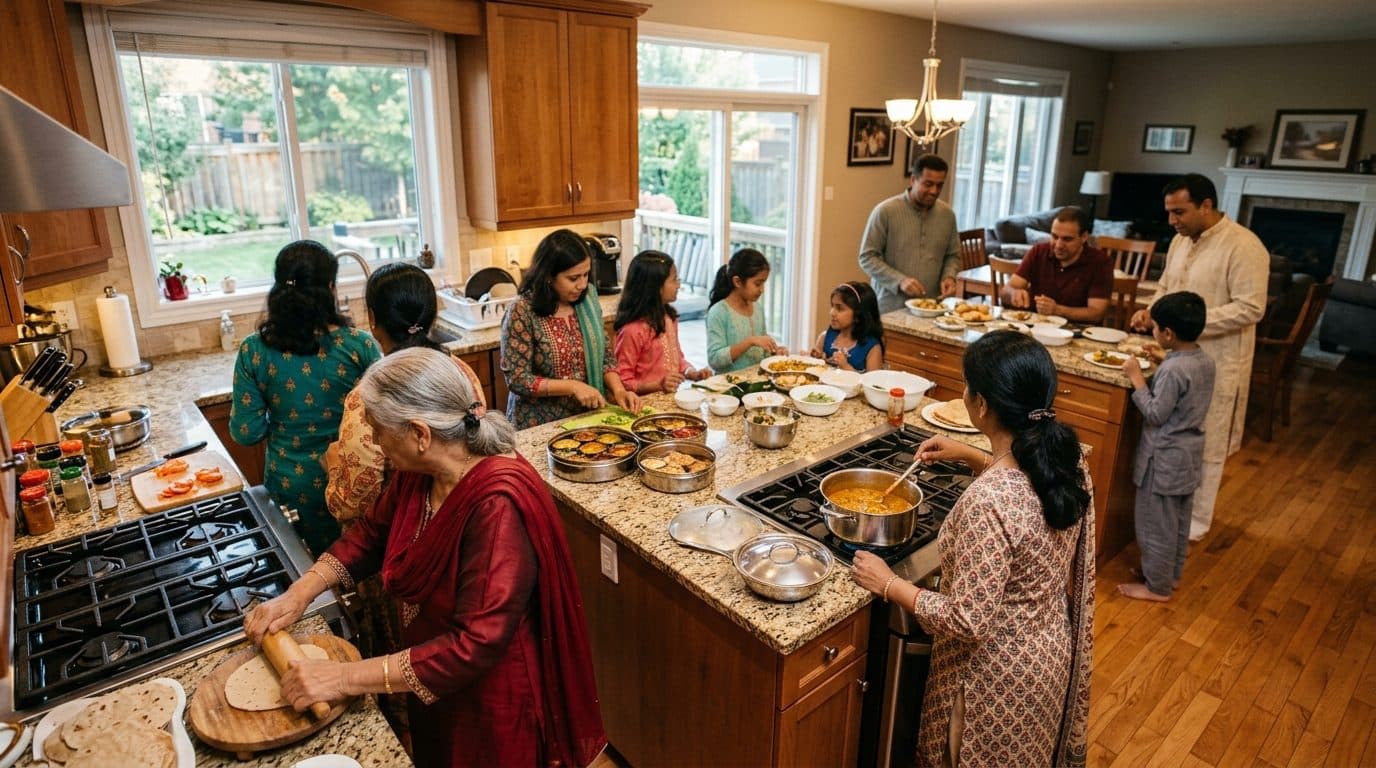
Real estate can be a family decision
A first-time buyer may be the one purchasing the property — but parents are often closely involved. The questions they ask tend to be the same ones, and they come in Gujarati.
“Area kevo chhe?” How is the area? “Future ma value kevi rehse?” What about its future prospects? “Basement chhe?” “School sari chhe?” “Indian community najik chhe?”
Those are not irrelevant questions. They reflect how families actually make decisions, and a representative who treats them as noise is going to lose the room.
Buying your first home after coming to Canada
For newcomers, the Canadian real estate system can feel unfamiliar. The terminology alone can be confusing, and most of these words carry a decision or a deadline behind them.
- Pre-approval
- Deposit
- Down payment
- APS — the Agreement of Purchase and Sale
- Conditions
- Firm offer
- Appraisal
- Title insurance
- Land transfer tax
- Closing adjustments
- Status certificate
Choosing the right city
Gujarati and Indian families are no longer looking only at one or two GTA cities. Depending on employment, affordability and lifestyle, buyers may consider a much wider set of markets — and each one is a different equation, not a different price tag for the same thing.
The honest position is that no single city is universally best. Each of these should be examined on its own terms against your own employment and family situation.
- Brampton — established South Asian community and GTA access.
- Mississauga — employment, airport access, mature neighbourhoods and transportation.
- Milton — newer family-oriented communities and GTA connectivity.
- Kitchener-Waterloo — technology, education and Waterloo Region employment.
- Cambridge — Waterloo Region access with a different housing and community profile.
- Hamilton — healthcare, education, industry and urban redevelopment.
- Oshawa and Durham — eastern GTA access and a different affordability and employment equation.
| City or region | What it is pointed to for |
|---|---|
| Brampton | Established South Asian community and GTA access. |
| Mississauga | Employment, airport access, mature neighbourhoods and transportation. |
| Milton | Newer family-oriented communities and GTA connectivity. |
| Kitchener-Waterloo | Technology, education and Waterloo Region employment. |
| Cambridge | Waterloo Region access with a different housing and community profile. |
| Hamilton | Healthcare, education, industry and urban redevelopment. |
| Oshawa and Durham | Eastern GTA access and a different affordability and employment equation. |
Multigenerational living
For some Indian families, housing needs include parents living with adult children, larger kitchens, additional bedrooms, a main-floor bedroom, multiple bathrooms, basement living areas, separate entrances and parking for several vehicles.
One warning matters more than any of the features: never assume a basement apartment or secondary suite is legal simply because it exists. Zoning, building permits, fire requirements and municipal rules all apply, and whether a unit satisfies them is a question to answer before you buy, not after.
Bringing money from India
Some buyers receive family assistance from India. This requires planning rather than improvisation.
Lenders, financial institutions, lawyers and other professionals may require documentation concerning the source and the transfer of the funds. Foreign-exchange, Canadian tax, Indian tax and legal implications can also depend on individual circumstances.
That is why buyers should coordinate with the appropriate mortgage, banking, accounting and legal professionals rather than relying on social-media advice.
Community matters — but so does your daily life
Being near a Gujarati or Indian community can be genuinely valuable. But do not choose a city solely because your relatives live there.
Where do you work? How often do you commute? Where will your spouse work? What can you comfortably afford? Do you need transit? Are schools important? What property type fits your family? Could your employment change? Will you still like the location five years from now?
The right community is the one that works for your overall life, not only for the weekend.
The right community is the one that works for your overall life, not only for the weekend.
The Gujarat-to-GTA perspective
Someone moving from Ahmedabad, Surat, Vadodara, Rajkot or Gandhinagar naturally looks for familiar characteristics in Canada: strong family networks, entrepreneurship, community events, vegetarian food, temples, cultural organizations, education, business opportunities, and neighbours with a shared language or traditions.
Those comparisons are cultural and lifestyle analogies. They are not claims that a Canadian city is economically equivalent to a city in Gujarat, and they should not be used that way when you are deciding where to put your money.
First-time buyers: do not let emotion determine your budget
One cultural pressure worth discussing openly is the desire to purchase a detached home immediately. There is nothing wrong with wanting a detached home.
But your first property does not have to be your forever property. Depending on your finances, a condo, a townhouse or a smaller home may provide a more manageable entry into homeownership. The right decision is personal, and it should survive a spreadsheet as well as a family conversation.
Robin’s perspective
Robin’s objective is not to tell Gujarati families to buy a particular house because everyone else is buying there. He would rather ask four questions.
Does this home fit your budget? Does this city fit your career? Does this property fit your family? Does this decision make sense five years from now?
Culture matters. Community matters. But so do affordability and long-term financial comfort.
Written by
Robin PatelSalesperson · The Agency Toronto
Updated
Published
Read in your language
A machine translation, not Robin’s words. For anything that decides money, ask him in Gujarati or Hindi directly.