Lake Ontario Water vs Groundwater in the GTA: What Home Buyers Should Know About Hard Water
Which GTA municipalities draw from Lake Ontario, which draw from wells, why Brampton’s water comes from a lake it does not touch, and what hard water actually costs you once you own the house.
The short answer
Municipal water in the GTA comes from Lake Ontario, from Lake Simcoe in parts of Georgina, or from groundwater wells, and the source changes community by community inside a single municipality. On a rural or semi-rural property, Robin Patel confirms the actual supply for that address, and asks whether any water softener is owned or rented.
Written forBuyers moving between GTA municipalities — especially anyone leaving a Toronto or Mississauga condo for a detached home in Caledon, Milton, Uxbridge or another groundwater-serviced community.
The short version
- GTA municipal water comes from Lake Ontario, from Lake Simcoe in parts of Georgina, or from municipal groundwater wells — and the source can change community by community inside one municipality.
- Brampton’s water comes from Lake Ontario through Peel Region even though the city is far from the shoreline, so distance from the lake tells you nothing about the source.
- Caledon, Milton, King Township, Stouffville, East Gwillimbury and northern Durham all contain both lake-serviced and groundwater-serviced communities — verify the specific address, not the city name.
- Lake water is not automatically soft: Durham’s lake-based system is reported as hard water, and several northern Durham groundwater communities are harder still.
- Hard water is a maintenance and appliance issue rather than a safety issue; municipal supply must meet Ontario’s drinking-water requirements whatever its source.
- A water softener, a water filter and a reverse-osmosis system do three different jobs — and if the house already has one, ask whether it is owned or on a rental contract that follows the property.
The line item nobody checks before closing
When buying a home in the Greater Toronto Area or the surrounding communities, buyers usually compare home prices, property taxes, schools, commute times, neighbourhoods and future development. One factor that is often overlooked is water.
Where does the home’s tap water come from? Is it supplied from Lake Ontario, Lake Simcoe, a municipal groundwater well or a private well? And perhaps most importantly for everyday living: how hard is the water?
Water source and hardness affect your daily routine, your plumbing fixtures, your appliances, your cleaning, your showering and whether you may want to install a water softener. For first-time home buyers, especially those moving from one GTA municipality to another, understanding these differences helps avoid surprises after closing.
Where GTA drinking water comes from
Municipal drinking water across the GTA generally comes from two major types of source. The first is surface water — primarily Lake Ontario, and in some communities Lake Simcoe. The second is groundwater, drawn from underground aquifers through municipal wells. Some rural properties also rely on private wells.
The exact source depends on the municipality, and sometimes on the specific community within that municipality. That last point is the one that catches buyers out, and it is the reason this page exists.
Toronto, Mississauga, Brampton and Caledon
The City of Toronto gets its drinking water from Lake Ontario, treating it at city water treatment facilities and distributing it across the city. Toronto describes its water as having relatively low levels of dissolved calcium and magnesium compared with many groundwater systems, so a water softener is generally not necessary for most Toronto homeowners.
Mississauga receives municipal drinking water supplied by Peel Region from Lake Ontario, through Peel’s lake-based treatment system.
Brampton also receives its municipal drinking water primarily from Lake Ontario through Peel Region’s lake-based system. This sometimes surprises buyers, because Brampton sits considerably farther north than the Lake Ontario shoreline. The water is treated near the lake and transported through Peel Region’s infrastructure. Do not assume that distance from the lake means a community uses groundwater.
Caledon is the interesting one, because the source changes depending on where in the town you are. Southern serviced portions of Caledon, including Bolton and other areas connected to Peel’s lake-based system, can receive Lake Ontario water. Several rural Caledon communities are served instead by municipal groundwater wells, and Peel Region identifies municipal well systems serving areas including Alton, Palgrave, Caledon East, Caledon Village, Cheltenham Village and Inglewood. Some rural Caledon properties also have private wells. If you are looking at a rural or semi-rural Caledon property, confirm the home’s actual water source rather than assuming it is uniform across the municipality.
Do not assume that distance from the lake means a community uses groundwater.
York Region: Vaughan, Markham, Richmond Hill, Aurora, Newmarket, King, Stouffville, East Gwillimbury and Georgina
York Region receives most of its water from Lake Ontario through agreements with Toronto and Peel Region. Vaughan, Markham and Richmond Hill are all identified by York Region as receiving Lake Ontario surface water — even though none of them sits on the lake, and the water travels a considerable distance through regional infrastructure before it reaches the home.
Aurora and Newmarket are different. York Region identifies both as receiving a combination of Lake Ontario water and groundwater, which means the characteristics of the water can differ from communities supplied exclusively by the lake. York Region’s reported hardness levels indicate that Newmarket’s municipal water is considered hard.
King Township is the clearest illustration of why the municipality name is not enough. King City is identified as blended Lake Ontario and groundwater, while Nobleton, Schomberg and Ansnorveldt are groundwater. The community of Stouffville receives blended lake and groundwater, while Ballantrae and Musselman’s Lake rely on groundwater. In East Gwillimbury, Mount Albert is identified as groundwater, while Holland Landing, Sharon and Queensville can receive a combination.
And not every GTA municipality is on Lake Ontario at all. Parts of Georgina, including Keswick and Sutton, receive municipal drinking water from Lake Simcoe.
Halton Region: Oakville, Burlington, Milton and the rural communities
Much of urban Oakville receives municipal drinking water sourced from Lake Ontario through Halton Region, and urban Burlington is also primarily supplied with Lake Ontario water.
Milton is another municipality where buyers should pay particular attention. Halton’s water system uses both Lake Ontario and groundwater. Historically, much of urban Milton has received Lake Ontario water while other portions have been supplied through groundwater systems, so water characteristics can vary depending on where the property sits. If hardness matters to you, verify the property’s specific municipal supply rather than relying on the city name.
Some smaller and rural Halton communities rely on municipal groundwater systems, serving portions of communities such as Campbellville, Carlisle and Freelton. Rural properties in these areas may also have private wells.
Durham Region: the south is lake, the north is groundwater
Durham Region uses both surface water and groundwater depending on the community. Lake Ontario water treatment facilities serve the major southern Durham communities, with supply plants located in Ajax, Whitby, Oshawa, Bowmanville and Newcastle.
Durham reports a hardness level for the lake-based system serving Pickering, Ajax, Whitby, Brooklin, Oshawa, Bowmanville and Newcastle that falls into the general category of hard water. That demonstrates something important on its own: Lake Ontario water can still be hard water.
Several northern and rural Durham communities rely on groundwater instead, and Durham identifies groundwater systems serving communities including Blackstock, Cannington, Greenbank, Orono, Port Perry, Sunderland and Uxbridge. Durham publishes approximate hardness levels for each, and several of these communities are substantially harder than the lake-serviced parts of the region. This is why a buyer moving from Toronto or Mississauga into a groundwater-serviced community may notice a significant difference from the first shower.
What is hard water?
Hard water is water containing higher concentrations of dissolved minerals, primarily calcium and magnesium. These minerals occur naturally. As groundwater travels through soil, limestone and other geological formations, minerals dissolve into the water — which is why groundwater is frequently harder than surface water.
Water hardness is commonly measured as milligrams per litre of calcium carbonate equivalent, and there is a standard classification running from soft, through moderately hard and hard, to very hard.
Hard water does not automatically mean unsafe drinking water. Municipally supplied drinking water must meet Ontario’s drinking-water requirements regardless of whether its source is a lake or groundwater.
How hard water affects everyday life
For homeowners, the effects of hard water are usually practical rather than dramatic. They show up as maintenance, not as emergencies — but they show up every week.
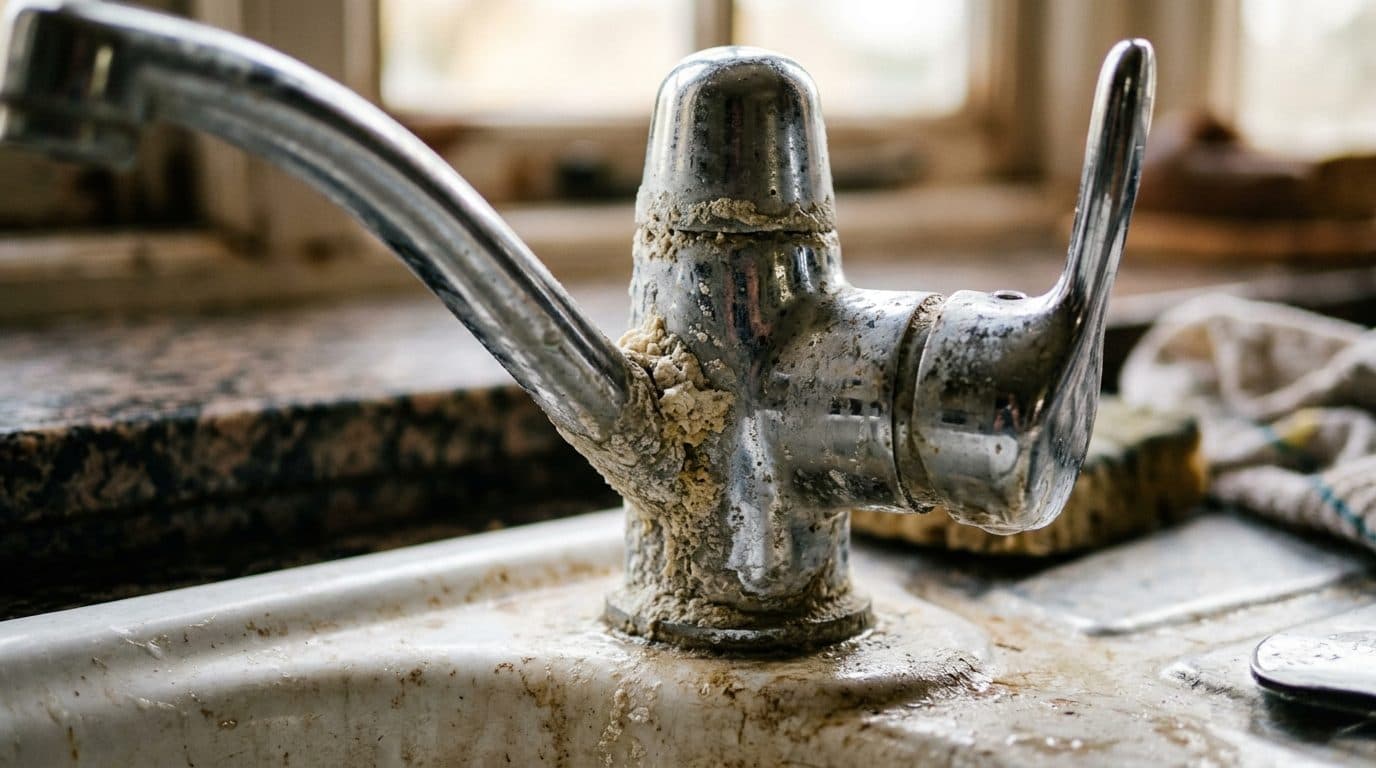
- White deposits around faucets. Chalky mineral buildup, called scale, appears around faucets, showerheads, sinks, bathtubs, glass shower doors, kettles and coffee machines.
- Shower glass. Hard water leaves visible mineral spots on a glass enclosure, and without regular cleaning those deposits become increasingly difficult to remove.
- Faucets and showerheads. Deposits accumulate around faucet aerators and inside showerheads, affecting appearance and potentially reducing flow. Periodic descaling may be necessary.
- Dishwasher performance. Spots on glasses, cloudy glassware, mineral residue and reduced detergent effectiveness are all common in hard-water homes.
- Washing machines and laundry. Hard water reduces how effectively soap and detergent lather, so households often use more detergent for the same result, and minerals accumulate in the appliance over time.
- Hot water tanks. Heating hard water contributes to scale forming inside the tank or on heating components, which over time can affect efficiency and maintenance requirements. Ask about the age and maintenance history of the hot water system.
- Kettles and coffee makers. If you regularly make chai, tea or coffee you will notice hard water quickly — electric kettles, coffee machines and espresso machines need more frequent descaling.
- Soap and shampoo. Hard water makes soap harder to lather, and people often notice shampoo and body wash behaving differently after moving into a harder-water community. That is mineral concentration, not a problem with the water.
- Plumbing fixtures. Over long periods, scale accumulates in fixtures and equipment, which is why hardness belongs in your ongoing cost-of-ownership thinking.
Do I need a water softener?
Not necessarily. A water softener is a personal household choice, not an indication that municipal water is unsafe. In communities with relatively low hardness, homeowners may decide a softener provides little benefit.
In very hard-water communities, homeowners may choose one to reduce mineral scale, improve soap lathering, reduce spotting, protect certain appliances and make cleaning easier. Before purchasing a system, find out the actual hardness of your municipal or well water.
One more distinction that trips buyers up: a water softener, a water filter and a reverse-osmosis system are three different things. A softener primarily addresses the minerals responsible for hardness, such as calcium and magnesium. A filtration system is designed to remove or reduce particular substances depending on the filter technology. A reverse-osmosis system is another type of treatment again. Each serves a different purpose.
Buying a home with a private well
A private well requires additional due diligence. Unlike a municipal system, responsibility for maintaining a private well generally belongs to the property owner — which is an important consideration when comparing an urban municipal-water property with a rural one.
- Water quality testing
- Well location
- Well depth
- Well record
- Flow or recovery rate
- Well pump
- Pressure tank
- Water treatment equipment
- Water softener
- Septic system location
- Separation between well and septic components
- Maintenance history
Does hard water affect a home’s value?
Usually, water hardness by itself is not something Robin would use to say that one home is automatically better than another. He looks at it as part of the total cost and lifestyle of owning the property.
A beautiful home in a very hard-water area may simply require a water softener and additional maintenance. A rural property with a private well may offer tremendous benefits, but the buyer should understand the responsibilities that come with maintaining a private water system. The goal is not to avoid groundwater. The goal is to know what you are buying.
Questions to ask before you buy
A little investigation before purchasing can prevent surprises after closing. Ask these questions about any property you are seriously considering — and pay particular attention to whether water-treatment equipment is owned or rented, because a rental contract follows the house.
- Is the property connected to municipal water or a private well?
- What is the source of the municipal water?
- What is the approximate water hardness?
- Does the property have a water softener?
- Is the water softener owned or rented?
- How old is the equipment?
- Is there a reverse-osmosis or filtration system?
- If there is a private well, when was the water last tested?
- What maintenance does the water system require?
- Are there rental contracts associated with any water-treatment equipment?
Robin’s perspective for GTA home buyers
When Robin helps a buyer evaluate a home, he looks beyond bedrooms, bathrooms and granite countertops. A home is where you are going to live every day, and that means understanding practical questions: where the water comes from, whether the home is on municipal water or a private well, how hard the water is, whether there is already a softener, whether it is owned or rented, and what maintenance to expect.
These details may not determine whether you buy the house, but understanding them before purchasing helps you make a more informed decision. It is particularly useful for first-time buyers moving between different parts of the GTA. Someone moving from a Toronto condo to a detached home in Milton, Caledon, Uxbridge or another groundwater-serviced community may experience water very differently.
The approach Robin takes is simple: do not just understand the house you are buying. Understand the lifestyle and ongoing responsibilities that come with it.
Frequently asked questions
Does Toronto get its drinking water from Lake Ontario? Yes. Toronto’s municipal drinking water comes from Lake Ontario and is treated before being distributed throughout the city.
Does Brampton get water from Lake Ontario? Yes. Brampton receives municipal drinking water through Peel Region’s Lake Ontario-based system.
Does Mississauga get its water from Lake Ontario? Yes, supplied through Peel Region’s Lake Ontario system.
Does Caledon use groundwater? Parts of it do. Some areas receive Lake Ontario water, while several communities use municipal groundwater wells, and some rural properties rely on private wells.
Does Vaughan get Lake Ontario water? Yes, supplied through York Region.
Does Newmarket have groundwater? Newmarket receives a combination of Lake Ontario water and groundwater through York Region’s system.
Does Milton have hard water? Water source and hardness can vary within Milton, because Halton Region uses both Lake Ontario and groundwater systems. Check the specific property’s supply.
Is groundwater safe to drink? Municipal groundwater systems are treated, tested and regulated under Ontario’s drinking-water requirements. Private wells require individual testing and maintenance by the property owner.
Is hard water unsafe? Hardness itself is generally a mineral and household-maintenance issue rather than an indication that municipal drinking water is unsafe.
Should I avoid buying a house because it has hard water? Not necessarily. Hard water is common in many Ontario communities. The more useful question is whether you understand the hardness level, the maintenance it implies, and whether a softener makes sense for your household.
| Municipality | Where the guide says the water comes from |
|---|---|
| Toronto | Lake Ontario, treated before being distributed throughout the city |
| Mississauga | Lake Ontario, supplied through Peel Region |
| Brampton | Lake Ontario, through Peel Region’s system |
| Caledon | Parts of it use groundwater — some areas receive Lake Ontario water, several communities use municipal groundwater wells, and some rural properties rely on private wells |
| Vaughan | Lake Ontario, supplied through York Region |
| Newmarket | A combination of Lake Ontario water and groundwater through York Region’s system |
| Milton | Source and hardness can vary within Milton, because Halton Region uses both Lake Ontario and groundwater systems — check the specific property’s supply |
A note on verifying any of this
This page is provided for general real estate and educational information only. Water sources, treatment systems and hardness levels can change and may vary within the same municipality or community.
Buyers should verify current information directly with the applicable municipality or regional water authority and obtain appropriate professional testing for private wells. Water quality, health and treatment questions should be directed to the appropriate municipal authority, public health authority or qualified water-treatment professional.
Written by
Robin PatelSalesperson · The Agency Toronto
Updated
Published
Read in your language
A machine translation, not Robin’s words. For anything that decides money, ask him in Gujarati or Hindi directly.