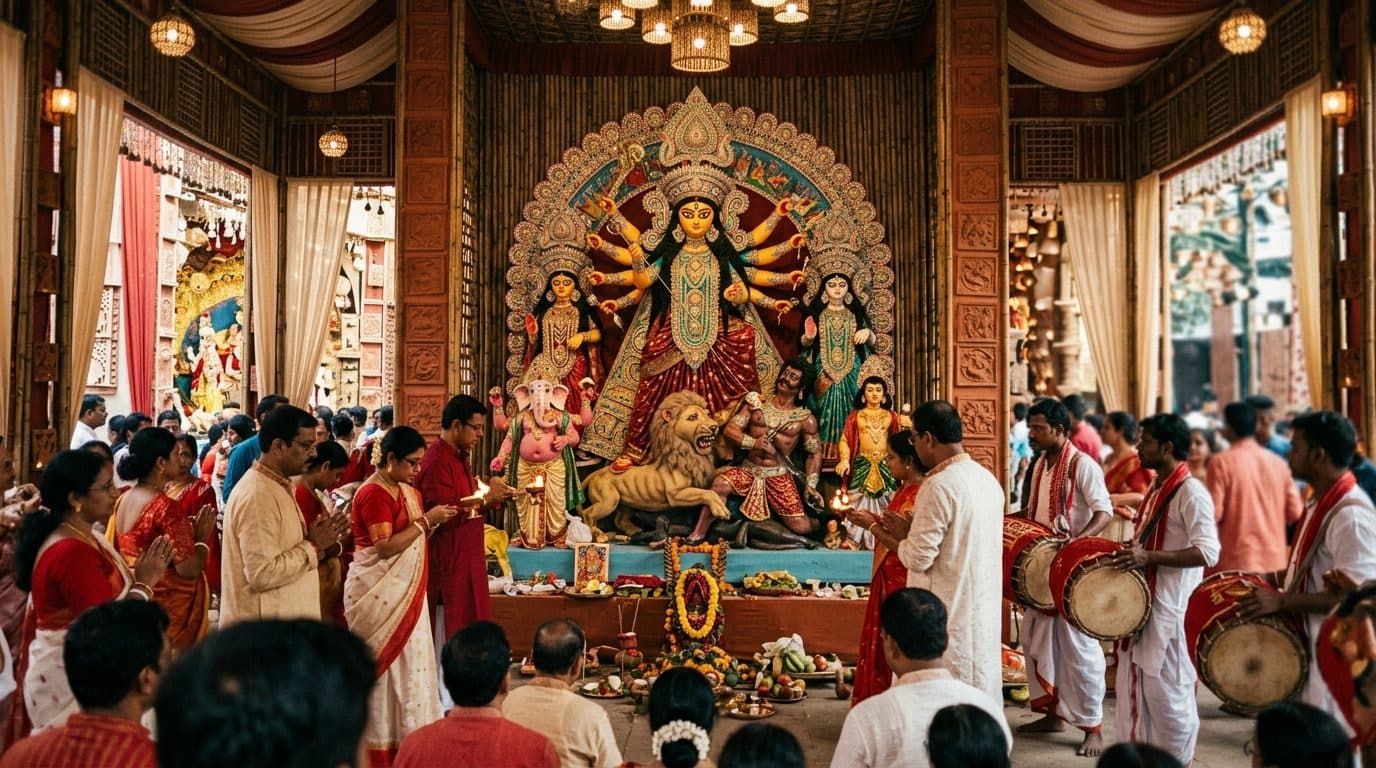
Durga Puja & Real Estate: How Much Should Community Decide Your Address?
In the GTA the pandal is a rented hall, not a permanent building — which changes how much weight community should carry when you choose a neighbourhood. How to weigh it honestly against commute, price and resale.
The short answer
Durga Puja in the GTA is hosted in rented halls rather than permanent buildings, so this year’s venue is a weak reason to choose an address. What is fixed in place is the groceries, the weekend classes and the people you already know. Robin Patel asks a family to rank each drive by how often they will make it.
Written forBengali and other South Asian families buying in the GTA — especially newcomers deciding between the area where they already know people and the area they can actually afford.
The short version
- In the GTA, Durga Puja is hosted in rented halls rather than permanent buildings, so proximity to this year’s venue is a weaker reason to choose an address than it first appears.
- The parts of community that are genuinely fixed to a location — groceries, weekend classes, year-round places of worship, the people you already know — are the parts worth weighting.
- Rank every destination by how many times a year you will actually travel to it. A drive you make four times a year is a very different purchase from one you make twice a day.
- Community, commute and price is usually a choose-two. Name the trade-off and rank it as a household before viewing, not during a bidding weekend.
- Resale is driven by how many kinds of buyer want the property. Weigh a community factor, but do not pay a premium the next buyer will not pay.
- Protect the puja dates at the offer stage, when the closing date is still negotiable — lawyers, movers and elevator bookings all run out.
What Durga Puja is
Durga Puja is the largest festival of the Bengali calendar. It honours the goddess Durga and her victory over the buffalo demon Mahishasura, and it is observed in the autumn month of Ashwin — which in Canada usually means somewhere in late September or October. The dates follow a lunar reckoning and move every year, so the puja never sits on the same Gregorian dates twice. If you are planning around it, check the coming year rather than assuming.
The main observance runs across Shashthi, Saptami, Ashtami, Navami and Dashami. Ashtami brings the pushpanjali, the offering of flowers. Dashami brings the visarjan, the immersion, and then Bijoya — the round of greetings and sweets that carries on for days afterward. In between there is the dhak, the dhunuchi dance, the bhog served to whoever walks in, and a great deal of simply being in one another’s company.
It falls in the same autumn window as Navratri and Dussehra, and people outside these communities routinely collapse all three into one thing. They are not one thing. For a Bengali family, Durga Puja is its own festival with its own rituals, its own food and its own emotional weight, and being told otherwise gets noticed.
In the GTA, the pandal is a rented building
In Kolkata the pandal is built for the festival and taken down after it. In the GTA it is almost always a booking. Bengali cultural associations across Toronto, Scarborough, Mississauga, Brampton, Markham and further out reserve community centres, school auditoriums, banquet halls and temple halls for the puja weekend, set the idol at one end of the room, and hand the keys back on Monday.
That one fact changes the real estate question more than anything else on this page. You are not choosing a home near a permanent building the way you might choose one near a mandir, a gurdwara or a church that sits on the same corner fifty-two weeks a year. You are choosing a home within reach of an organization — and organizations move venues. A hall available this year can be booked out next year, and the puja follows the booking.
So the honest version of the question is not “how close is the pandal?” It is “how close are the people, and what else about this area is fixed in place?”
You are choosing a home within reach of an organization — and organizations move venues.
Cultural infrastructure is still real infrastructure
None of the above is an argument for ignoring community. It is an argument for being precise about which parts of it are actually attached to a location. Some of it genuinely is, and none of it appears anywhere on a listing.
Buyers tend to underrate this while they are shopping and feel it after they move. Price, square footage and commute are easy to compare on a spreadsheet. The first February in a subdivision where nobody knows your name is not on the spreadsheet, and it is the thing families most often tell Robin they wish they had weighted differently.
- Groceries that stock what you actually cook — fish counters, mustard oil, the specific spices, sweets. These are fixed to a plaza and they do not move often.
- Weekend language, music and dance classes for children. These usually run out of the same building for years and are one of the strongest reasons families stay in an area.
- Places of worship used year-round, as distinct from a hall rented for four days.
- Restaurants and sweet shops that make the drive worth it on an ordinary Tuesday, not just on a festival day.
- The density of people you already know. Who else lives on that street or in that building is the single most useful thing to find out, and the only way to find it out is to ask.
- The practical safety net — the neighbours who will take your kid to school when someone is in hospital. That is what people mean by community, and it is not a service you can buy.
Sort every drive by how often you will actually make it
Here is the exercise that resolves most of these arguments inside a family, and it takes ten minutes. Write down each destination that matters and how many times a year you will genuinely travel to it. Then look at the ranking rather than the feeling.
The puja itself is a handful of days a year. Weekend classes might be thirty Saturdays. The grocery run is weekly. The commute, for most people, is eight to ten trips a week, every week, for years. When families rank those honestly, the address that wins is often not the one they walked in assuming.
This is not an argument that the commute always wins. It is an argument that the trade-off should be made with the frequencies in front of you, because a forty-minute drive you make four times a year is a very different purchase from a forty-minute drive you make twice a day.
| Destination | How often you will genuinely make the trip |
|---|---|
| The puja itself | A handful of days a year |
| Weekend classes | Might be thirty Saturdays |
| The grocery run | Weekly |
| The commute | For most people, eight to ten trips a week, every week, for years |
Community, commute and price: you are choosing two
In this market almost nobody gets all three. Buying further out — Milton, Georgetown, Caledon, Kitchener-Waterloo — generally buys space and price and costs commute. Buying into an established community closer in often costs property type: the same budget becomes a condo or a townhouse instead of a detached home. Buying near work in the core usually costs both space and price.
The mistake is rarely the trade-off itself. The mistake is making it without naming it. One family decides on price alone and discovers the isolation months later. Another decides on community alone and spends three hours a day on the 401 until somebody changes jobs. Both would have chosen differently if the third factor had been on the table at the start.
The fix is unglamorous: write the three down, rank them as a household before you view anything, and let that ranking decide when a specific property forces the choice. Decisions made in advance survive a bidding weekend. Decisions made on a Sunday afternoon in a full open house usually do not.
What supports resale is a different list
The factors that make a neighbourhood work for your family and the factors that support its resale value overlap, but they are not the same list. Resale is driven by how many different kinds of buyer could want the property: transit and highway access, schools, everyday retail, employment within reach, and the range of household types the layout suits.
A factor that serves only your community serves only your community when it is time to sell. That is not a reason to ignore it. It is a reason not to pay a premium for it. The strongest version of this decision is a property that would sell well on its own merits and happens to sit where your people are — rather than a compromised property justified entirely by proximity.
- If this street were empty of everyone you know, would you still want the house?
- Who is the next buyer for this property, and is that a large group or a narrow one?
- Am I paying above the comparable sales for something the next buyer will not value?
- If the association books a different hall in three years, does this address still make sense?
The puja week and your closing date
Many families want to keep the puja days clear of a closing, a move, or a firm-offer deadline. That is a scheduling preference, not a prediction about the market, and it is worth stating out loud early. You cannot be in two places, and neither can the people helping you.
The practical constraints are the ones that bite. Your lawyer’s office has a finite number of files it can close on a given day. Movers book out. A condo move needs an elevator reserved well in advance. And the friends who would have carried boxes are all at the same hall you would have been at.
Autumn is also one of the busier stretches of the Ontario real estate year, so an October closing competes for the same movers and the same lawyer’s calendar as everybody else’s. The time to protect a date is at the offer stage, when the closing date is still a negotiable term. Moving it afterward is possible, but it costs money and goodwill, and sometimes it is simply not available.
If you have been in Canada under two years
A first year of renting in the area you think you want is not wasted money if it teaches you the commute in January, the actual drive to the grocery you actually use, and whether the people you moved near are people you see. Plenty of families buy immediately and are glad they did. The point is that renting first is a legitimate strategy rather than a failure, particularly when you are still learning the region.
On the financing side, a shorter Canadian credit history and less time in a Canadian job change what a lender looks at, and some lenders have programs built for exactly that situation. That is a conversation for a mortgage professional early, not a surprise to discover at offer time.
One last thing worth saying plainly: your cousin’s purchase three years ago is not a template. Their price, their rate, their household size and their timing were all theirs. Use their experience for local knowledge, not as a decision.
How Robin works with this
Robin is Gujarati. Durga Puja is not his festival and he is not going to write as though it is. What he does have is enough experience with Bengali families across Toronto, Markham, Mississauga and Brampton to know that the puja week is a bad week to schedule a move, and that “near the community” means something different in every household that says it.
His job on this particular decision is to make the trade-off visible and then get out of the way: here is the drive at 8 a.m. rather than at noon, here is the price difference for the same square footage two municipalities over, here is what this property would look like to the next buyer, and here is how many times a year you would genuinely make that trip. The family decides. He makes sure they are deciding with the real numbers.
He works with The Agency Toronto and speaks Gujarati, Hindi and English. Where a client would rather have part of the conversation in Bengali, that is what a trusted interpreter in the family is for, and nobody should pretend otherwise.
Written by
Robin PatelSalesperson · The Agency Toronto
Updated
Published
Read in your language
A machine translation, not Robin’s words. For anything that decides money, ask him in Gujarati or Hindi directly.